
Anthony Maguire, Director – Longevity Power and Kate Power, Senior Sustainability and Energy Analyst
Conventionally, anyone owning a solar PV system is considered to be exporting power if they are generating more electricity than they are consuming at any given time. However, at a systems level, this doesn’t make a lot of sense. A generator will be connected to the same electrical transformer or sub-station as countless other consumers who do not generate any electricity; at a local level, this means that the electricity is not being exported at all. Rather, it is being generated and consumed by all those that sit on that sub-station. This is important for lots of reasons, not least because the price paid for exported power is typically much lower than the retail price, and often even the wholesale price of electricity. Up until now there has been no means by which generators can sell their power to other local consumers, be that houses on the same street, or units within the same business park. However, that is all about to change with the onset of collective self-consumption (CSC).
What is collective self-consumption (CSC)?
Before diving in, it is important to get the terminology straight. Put simply, CSC is an arrangement that allows owners of renewable energy installations to share self-generated electricity with households, businesses, or other entities within a specified distance, on a contractual basis. The terms ‘energy sharing’ and ‘peer-to-peer energy trading’ are often used as synonyms for CSC, particularly in EU documents like the second EU Renewable Energy Directive (RED II). It’s also common to see CSC mentioned when speaking about renewable energy communities (REC), as both concepts were first introduced in the RED II. The key difference between them is that RECs are organisational structures that promote citizen engagement and ownership in electricity generation and consumption, whereas CSC is an activity that can take place within, or outside of, a REC.
How does collective self-consumption (CSC) work?
CSC allows individual small-scale generators to sell their electricity to nearby consumers, without the need for a physical connection. It complements other frameworks for individual self-consumption, energy communities or energy cooperatives, and virtual net-billing. For those who want to participate in CSC, all they have to do is opt into the scheme, and the entity responsible for the local electricity network (the distribution system operator or DSO) does the rest, estimating the amount of power that they would have consumed had they been physically connected to the system.
The solution underpinning CSC is decidedly low-tech: no blockchain or fancy metering necessary. The approach varies from country to country, but it is essentially just an equation that apportions a pre-agreed upon amount of exported power to different consumers based on their consumption patterns. The amounts apportioned to each consumer can be fixed or dynamic. Dynamic equations allow for better matching of the exported generation to consumer demand but are not present in all countries.
Why is it important?
In countries which lack the generous long-term export tariffs of Germany, France and the Netherlands or the net-metering programmes of several US states, large rooftops and car parks have largely been left underutilised. The reason for this is that unless the building owner has very high electricity consumption, utilising a large roof space or car park with solar panels is likely to generate far more electricity than they would ever need. The most striking example of this is a shopping outlet, where the electricity consumption may be split between hundreds of different consumers. Splitting up a solar PV array such that each unit had their own designated system would be impractical and costly. However, with collective self-consumption, retail tenants can simply opt in, and enjoy the benefits of zero carbon electricity at a lower cost and more stable price than grid electricity.
When it comes to residential units, CSC is a game-changer. In countries such as Spain where over 65% of the population lives in an apartment block, solar PV has failed to effectively penetrate the residential market. This is largely down to the fact that there has been no equitable way of determining who should benefit from a rooftop solar array. It would be impractical, and in many cases technically impossible to physically split a small rooftop array between dozens of separate units. However, CSC allows the generation to be split virtually between all units that wish to opt-in.
Where is it possible?
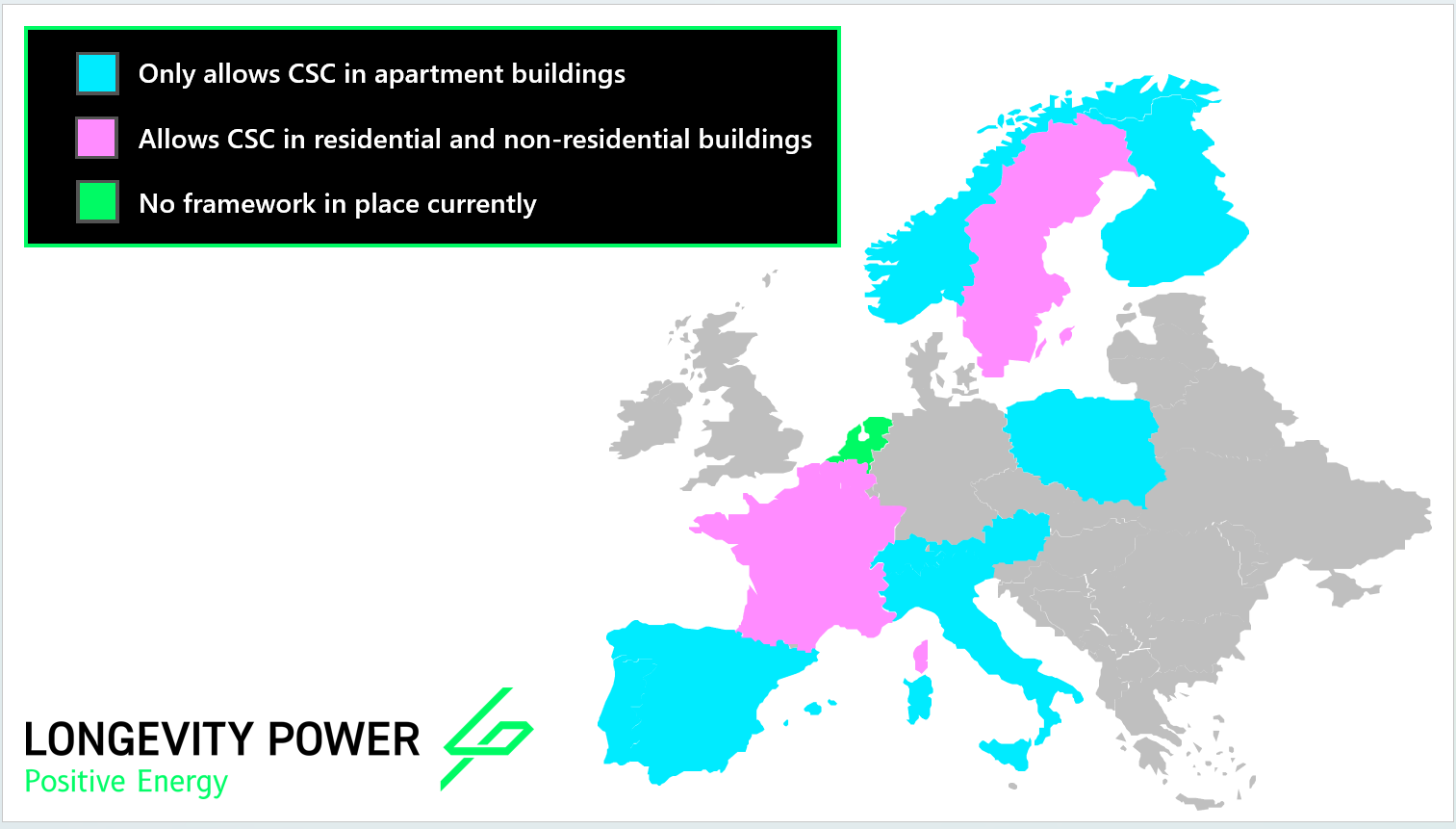
RED II is the driving force behind the spread of CSC in Europe. It requires all Member States to allow CSC, at a minimum, within apartment blocks. Despite a June 2021 deadline, not all Member States have transposed RED II into national law. Among those countries that have transposed it, the types of CSC arrangements they allow for can take on many different forms, as outlined in the table below.
|
Country |
Maximum Capacity |
Distance |
Legal Entity Formation Requirement |
CSC-specific Incentives |
|
Austria |
None |
Limited to same low voltage or medium voltage substation |
Yes |
Yes, electricity tax exemption. |
|
Belgium |
None |
Limited to the same building in Brussels-Capital Region and Wallonia |
Depends on the region |
Yes, electricity tax and grid fees exemptions in all regions. |
|
Czech Republic |
50 kW |
Limited to apartment buildings |
No |
None found |
|
France |
3 MW |
2km1 |
Yes |
None found |
|
Germany |
100 kW |
Limited to apartment buildings |
No |
Yes, exemptions from grid fees and electricity tax. |
|
Italy |
200 kW |
Limited to the same building (residential and non-residential) |
Yes |
Yes, subsidies as well as grid fee exemptions |
|
Norway |
1 MW |
Limited to same property (cadastral reference) |
No |
Yes, exemption from electricity consumption tax and grid fees |
|
Poland |
1 MW |
Limited to the same building (residential and non-residential) |
Yes |
Yes, exemption from electricity consumption tax |
|
Portugal |
None |
Low voltage: 2km Medium voltage: 4km High voltage: 10km Very high voltage: 20km |
Yes |
Yes, electricity tax exemptions and capital grants |
|
Spain |
None2 |
2km |
No |
Yes, exemption from grid fees |
|
Sweden |
None |
Limited to same property (cadastral reference) |
No |
None found |
|
Switzerland |
None |
Limited to same or adjacent plots of land |
Yes |
None found |
|
1. Distances of up to 20km are permitted for isolated projects in low population density areas. 2. Spain permits three different kinds (modalities) of CSC and one modality has a capacity limit of 100kW while the other modalities have no capacity limits. |
||||
How can Longevity Power help?
Whether you own business parks, apartment blocks or shopping centres, CSC is likely to be a game-changer for your business if you own assets in any of the participating countries. Not only does it provide a very lucrative form of additional revenue which could significantly enhance the value of your asset, it represents the single most effective way of reducing the operational emissions of your tenants. If you would like to receive a detailed market review, summarising the country-level policies for CSC across Europe, just reach out to Anthony Maguire at [email protected].